Last updated: November 18, 2026
Key Takeaways
- Inkjet uses liquid ink; laser uses dry toner fused to paper with heat.
- Inkjet is the best fit for photos, school projects, color handouts, and light home printing.
- Laser is the stronger choice for text-heavy jobs and steadier office-style use.
- Inkjet usually wins for photo quality, which is the clearest difference here.
Quick Answer
Inkjet vs laser printer: which is better for your needs? For most people, the answer is simple: laser is better for text and higher page volume, while inkjet is better for photos and lighter use. A printer guide only matters if it helps you avoid the wrong machine, so I’m going to make the decision plain. If you want the broader buying context, the printer buying guide is the right next stop after this comparison.
Inkjet wins for photos, color graphics, and occasional home printing; laser wins for sharp text, higher page volume, and lower hassle when a printer sits unused for weeks. The right choice comes down to what you print most, how often you print, and whether you care more about photo quality or text speed.
What actually changes between an inkjet and a laser printer?
Inkjet uses liquid ink from an ink cartridge; laser uses dry toner fused to paper with heat. That one difference explains almost everything people notice: photo color, text sharpness, running cost, warm-up behavior, and what happens when the printer sits idle for a while.
Inkjet printers spray microscopic droplets, which gives them a real advantage on glossy photo paper and mixed-color documents. Laser printers place toner very quickly, which is why they tend to excel at crisp black text and steady document runs. Many consumer lasers are also monochrome, while color lasers exist but often cost more to buy and to maintain.
The practical split is easy to remember. Inkjet is the better fit when image quality matters more than speed or volume. Laser is the better fit when documents matter more than photos, especially if the printer may handle dozens of pages at a time.
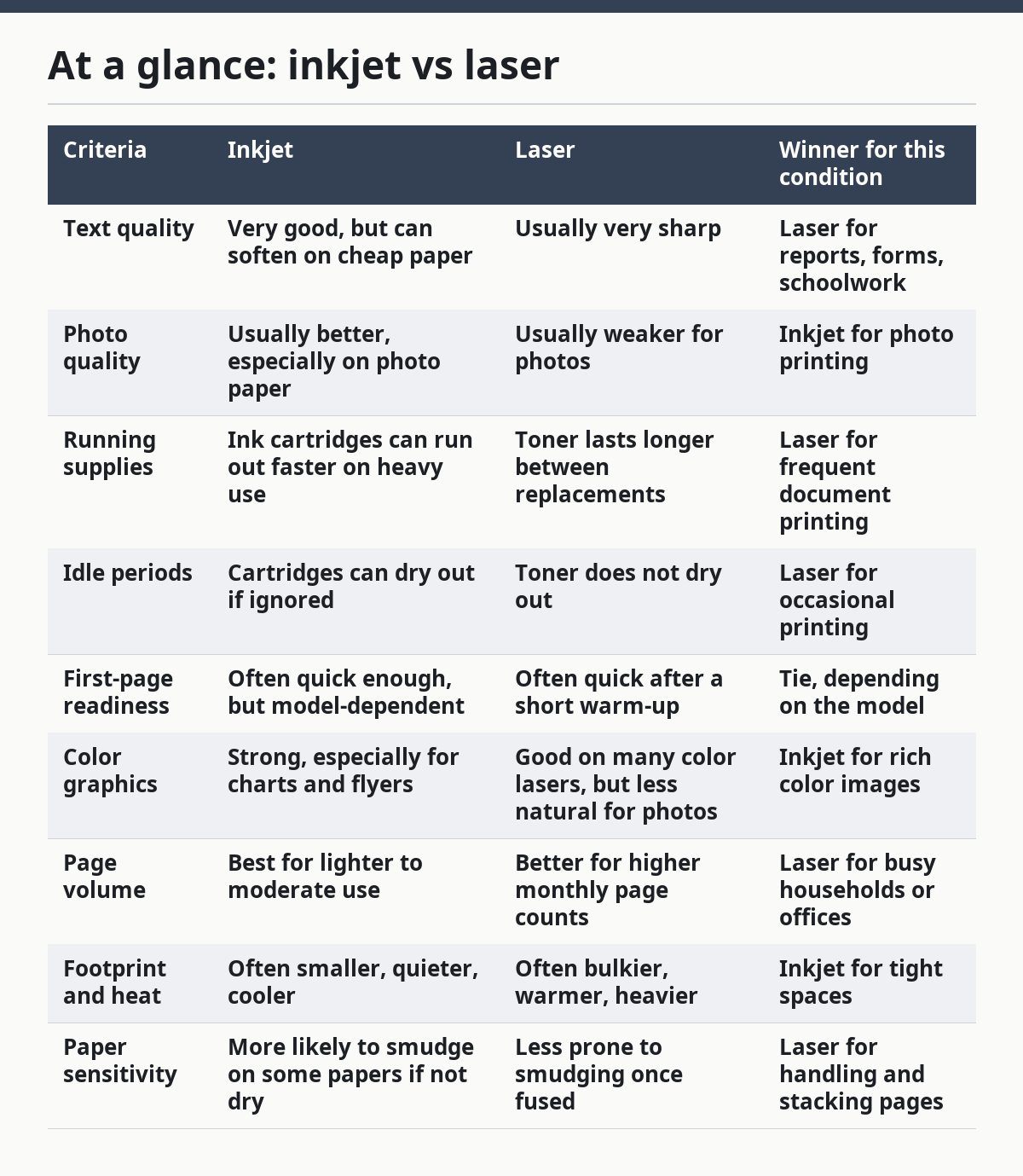
At a glance: inkjet vs laser
| Criteria | Inkjet | Laser | Winner for this condition |
|---|---|---|---|
| Text quality | Very good, but can soften on cheap paper | Usually very sharp | Laser for reports, forms, schoolwork |
| Photo quality | Usually better, especially on photo paper | Usually weaker for photos | Inkjet for photo printing |
| Running supplies | Ink cartridges can run out faster on heavy use | Toner lasts longer between replacements | Laser for frequent document printing |
| Idle periods | Cartridges can dry out if ignored | Toner does not dry out | Laser for occasional printing |
| First-page readiness | Often quick enough, but model-dependent | Often quick after a short warm-up | Tie, depending on the model |
| Color graphics | Strong, especially for charts and flyers | Good on many color lasers, but less natural for photos | Inkjet for rich color images |
| Page volume | Best for lighter to moderate use | Better for higher monthly page counts | Laser for busy households or offices |
| Footprint and heat | Often smaller, quieter, cooler | Often bulkier, warmer, heavier | Inkjet for tight spaces |
| Paper sensitivity | More likely to smudge on some papers if not dry | Less prone to smudging once fused | Laser for handling and stacking pages |
Inkjet printer: who should actually buy one?

Inkjet is the right choice for anyone who prints photos, school projects, color handouts, or a few pages at a time. It also makes sense if the printer will sit in a home office corner and only wake up once or twice a month.
The big strength is image quality. A good inkjet can handle gradients, skin tones, and saturated colors better than most consumer lasers, especially on photo paper. That matters if you print family pictures, craft labels, posters, or presentation graphics that need to look polished instead of merely legible.
Inkjet is also easier to justify when your page volume is low. If you print ten pages this week and nothing for two weeks after that, toner’s endurance matters less than whether the machine can produce a clean color page when you need it. Many inkjets are physically smaller than lasers too, which helps if the printer shares a shelf with books or sits beside a laptop.
The drawback is just as real: ink cartridges can become the expensive part of ownership, especially if you print mostly text or let the machine do long cleaning cycles. Cartridge replacement frequency is the pain point, not the box price. Some owner reviews also complain about clogs or wasted ink after long idle periods, and that risk rises when the printer is used sporadically.
Skip inkjet if you print piles of black-and-white pages, want the least fussy document machine, or dislike dealing with ink drying issues. It is the wrong fit for a student who prints lecture notes every day, a small office with steady output, or anyone who wants a printer that stays ready after a month of sitting unused.
Laser printer: where it wins and why text people prefer it
Laser wins for text-heavy printing, and it wins decisively for people who want a printer that behaves like office equipment instead of a temperamental appliance. If the job is invoices, reading packets, shipping labels, tax forms, or long black-and-white documents, laser is usually the cleaner choice.
The strongest argument is toner. Toner is a dry powder, so it does not dry out the way liquid ink can. That makes laser printers especially attractive for occasional users who still want reliable output after weeks of inactivity. It also helps with page volume: toner is built to handle long document runs without the same stop-start anxiety that can come with cartridges.
Text quality is the other obvious reason. Laser printers are known for crisp edges and consistent black output, especially on plain office paper. If the page is mostly words, a laser usually gives a more professional result with less smearing and less waiting for pages to dry.
Laser is not the universal answer, though. Many models are bulkier than inkjets, and color lasers are not the obvious fix for photo printing. They can be excellent for charts and business graphics, but they rarely beat a good photo inkjet for skin tones, subtle shading, or glossy prints. Some lasers also cost more up front, and replacement toner can be a sizable purchase even when it lasts a long time.
Laser is not the best pick for someone who prints lots of photos, wants a very compact device, or only needs the occasional colorful school project. It is also overkill if you mostly print a few snapshots and a couple of return labels each month.
Which printer is better for photos?
Inkjet is better for photos, and that is the simplest call in this entire comparison. A photo-oriented inkjet can reproduce smoother color transitions and richer tones on photo paper than a typical laser printer.
The reason is technical, not marketing fluff. Inkjet lays down liquid color in a way that suits photographic images, while laser relies on toner particles and heat, which is excellent for sharp documents but less natural for photo rendering. A laser can print a photo in the casual sense, but “acceptable” and “photo quality” are not the same thing.
This matters if you print family albums, school art projects, craft images, or anything that will be looked at closely. It matters less if the image is just a chart in a presentation or a small logo on a memo. In those cases, either technology can be fine.
The main downside of inkjet photo printing is maintenance and cost. Photo cartridges, color ink consumption, and paper choice all affect the result. If your “photo printing” is actually only a few snapshots a month, you may still prefer laser for everything else and send the photo work elsewhere. But if photo quality is the priority, inkjet is the clear winner.
Which printer is better for text?
Laser is better for text, especially when you want crisp black pages and dependable handling of large document runs. It is the better match for contracts, study packets, forms, and anything that lives in a filing cabinet after printing.
Inkjet can still produce excellent text, and many modern models are sharp enough for ordinary home use. The difference shows up more in consistency and convenience than in basic readability. Laser tends to be steadier on plain paper, less likely to smudge, and more comfortable when the workload turns into 30-page or 50-page stretches.
A second advantage is rhythm. Laser printers are built around documents, so they are often quicker to get through repetitive black-and-white work. That matters in a home office, shared household, or classroom environment where the printer may see bursts of activity instead of one page at a time.
The limitation is obvious: text strength does not make laser a photo specialist. If your pages mix documents with lots of color images, a laser can still be the better single-device answer for text-first use, but it will not match inkjet for photos. It is excellent at one job and merely decent at another.
Running costs, page volume, and what people forget to factor in
Laser usually has the edge on running costs for heavy document printing, and inkjet often makes more sense for low-volume users who care more about purchase flexibility than long-run efficiency. The important variable is page volume, not just the sticker price of the printer.
Toner generally lasts through more pages than a typical ink cartridge, which is why laser often wins when the printer is used often. That advantage becomes more valuable as monthly page count rises. A person printing 5 pages a week has very different economics from a person printing 100 pages a week, even if both want a machine on the same desk.
The hidden cost for inkjet is not only the cartridge itself. It is also the annoyance of a cartridge that runs dry at the wrong moment, color ink that gets used up in cleaning cycles, and the temptation to replace multiple colors sooner than expected. The hidden cost for laser is that toner replacement can be more expensive at once, even if the total service interval is longer.
What people forget most is usage pattern. A high-volume household, tutoring business, or small office benefits from laser’s stamina. A light user who prints a return label, a boarding pass, and a worksheet now and then may be happier with a modest inkjet, especially if photo quality matters. The wrong choice here is usually not “bad printer”; it is “wrong printer for the page count.”
The honest verdict: which one should you choose?
Choose laser if you print mostly text, want lower-maintenance document printing, or expect regular page volume. Choose inkjet if photos, color graphics, and occasional home use matter more than raw document efficiency. Neither if you need both excellent photos and heavy-duty office printing from one machine without compromise; that is where expectations get unrealistic.
That is the cleanest answer. Laser is the safer default for text-first homes and offices. Inkjet is the better fit for image-heavy, lighter-use households. If you only remember one rule, remember this: toner is for documents, ink cartridge systems are for pictures.
When the usual answer flips
Inkjet can still be the better choice for a text-heavy user if photo quality is non-negotiable and print volume is low. A parent printing a mix of homework, tickets, and family photos will often care more about output variety than toner efficiency.
Laser can also be the better choice for an occasional user if the printer may sit idle for long stretches. Toner does not dry out, so a laser is often the safer pick when printing happens once every few weeks and reliability matters more than color richness.
A third exception is shared household use. If several people print different things from the same device, laser’s consistency can make life easier even when one person wishes for better photo output. The machine that causes fewer surprises often wins.
A fourth exception is tight spaces with low output. If the printer lives on a narrow shelf and rarely prints more than a few pages, a compact inkjet can be the more sensible purchase simply because it fits the room and the use pattern.
Before you buy, check these two standards
Laser is not automatically better just because it sounds more office-like, and inkjet is not automatically better because it handles color. The practical check is simple: look at the maker’s rated page yield and the printer’s supported paper sizes before buying.
If you care about cartridge or toner availability, check the official supply listings from the manufacturer and major retailers such as Amazon, Best Buy, or Walmart before choosing a model. If you want a broader framework for comparing printer features beyond the technology choice, the printer buying guide on this site is the next useful stop.
For general consumer guidance, the U.S. Federal Trade Commission’s consumer advice on shopping carefully is a useful reference point, and the Consumer Reports printer buying advice is worth consulting if you want a second opinion from a long-running testing organization.
Is a laser printer cheaper to run?
Usually yes, if you print regularly. Laser printers typically use toner that lasts longer than an ink cartridge, so the running cost per page is often lower for text-heavy use. The trade-off is that the upfront purchase and replacement toner can cost more at once, so occasional users may not feel the savings.
Which printer is better for photos?
Inkjet is better for photos. It handles color gradations, skin tones, and glossy paper more naturally than most consumer laser printers. A laser can make acceptable color images for charts or casual use, but it is not the right choice when photo quality is the goal.
Which printer is best for occasional use?
Laser is usually best for occasional use if you mainly print documents. Toner does not dry out, so the printer is more likely to be ready after sitting untouched for weeks. Inkjet can still make sense for occasional users who care about photos, but unused cartridges can become a nuisance.
Drafted with AI; not yet reviewed by a person.