Imagine a world where sharing information was incredibly difficult. Before the printing press invention, if you wanted a copy of a book, you had to painstakingly hand-copy it. Think about how long that would take! This post explores the fascinating story behind the printing press invention, tracing its journey from a groundbreaking idea to a catalyst for societal change. You’ll gain a thorough picture of its mechanics, its impact on knowledge distribution, and how it helped shape the modern world. Learn about the key players, the technological innovations, and the wide-ranging effects that followed. This blog post will help you appreciate the importance of information accessibility and how it has changed the way we learn and communicate.
Key Takeaways
- Discover the historical context surrounding the printing press invention and its inventor.
- Learn about the mechanical innovations that made the printing process efficient.
- Explore the societal impacts, from education to the spread of new ideas.
- Understand the significant role the printing press played in the Renaissance and the Reformation.
- Explore the types of materials printed and how it evolved over time.
- Identify its influence on information accessibility for the common person.
The Genesis of a Revolutionary Idea
Before the printing press invention, knowledge was a luxury. Books were rare, expensive, and primarily accessible to the wealthy elite and the clergy. Scribes, working in monasteries and scriptoria, painstakingly copied texts by hand. This manual process was slow, laborious, and prone to errors. Consequently, the availability of books was severely restricted, hindering the spread of information and ideas across Europe and beyond. The need for a faster and more efficient way to reproduce text was becoming increasingly evident as interest in learning and knowledge grew, fueled by the rediscovery of classical texts and the rise of universities.
The concept of movable type was not entirely new. The Chinese and Koreans had experimented with similar techniques using materials such as wood and clay. However, these methods, though innovative, proved to be cumbersome for large-scale production. The material used in East Asia, like wood, was subject to deterioration, and the complex nature of the Chinese language, with its thousands of characters, presented challenges. This limited the practical application of their techniques for mass communication, setting the stage for a new phase in the printing evolution.
The Life and Times of Johannes Gutenberg
Johannes Gutenberg, a goldsmith from Mainz, Germany, is credited with the invention of the printing press using movable type in the mid-15th century. While historical records are scarce, it is widely believed that Gutenberg had previous experience in metalworking, which was essential for designing and manufacturing the intricate components of his press. He realized the potential of creating durable, reusable characters that could be arranged to form words and sentences, then used to print multiple copies of a single text. This idea, paired with his knowledge of alloys and printing processes, revolutionized the way information was produced and disseminated.
Gutenberg’s background as a goldsmith provided him with the necessary skills to create the individual metal letters. His insight into combining existing technologies, such as the screw press, often used for pressing grapes, with the design of individual, reusable letters was innovative. Gutenberg’s vision was to find a more efficient way to produce books in large quantities. This aim drove him to solve the technical challenges associated with creating an effective, long-lasting printing system.
- Gutenberg’s Background: A goldsmith’s expertise in metalworking was crucial for crafting durable and precise movable type.
- The Screw Press Inspiration: Using a modified screw press, originally used for wine-making, created the necessary pressure for printing.
- The Gutenberg Bible: The first major work printed, it showed the potential of mass-produced texts.
- Innovation in Ink: The development of oil-based ink, which adhered to the metal type and paper more effectively.
The Mechanical Marvel: How the Printing Press Worked
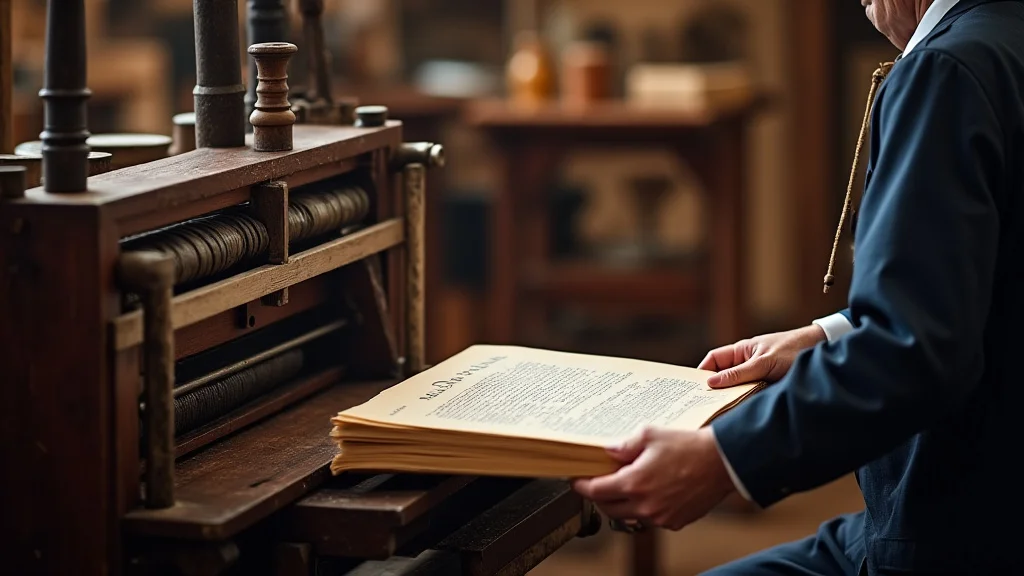
The printing press, as invented by Gutenberg, was a sophisticated device for its time. At its core, the process involved several key steps. First, individual metal letters, each representing a character, were arranged in a composing stick to form words, lines, and pages. These letters were held together by a frame. Next, the composed pages were inked using a special ink designed to stick to the metal type. Then, the inked type was placed onto a printing bed, and paper was positioned on top. Finally, a screw-operated press was used to apply pressure, transferring the ink from the type onto the paper. The result was a printed page.
The process of typecasting, the creation of individual letters, was itself a complex operation. The letters were made from a metal alloy. This metal was durable, but it had to be soft enough to cast at a low temperature. This allowed it to take the precise form of a mold. The molds ensured uniformity in size and shape of all the characters. It was a major time-saving element and vital to the effectiveness of the process.
- Movable Type: Individual letters made from metal were the foundation.
- The Printing Bed: This held the arranged type ready for printing.
- The Ink: Oil-based ink was developed to provide good adhesion to both the metal and the paper.
- The Screw Press: This provided the necessary pressure to transfer the image onto the paper.
Impact on Society: Knowledge for All
The printing press invention had a dramatic impact on society, sparking major changes in European culture, education, and politics. Before the printing press, knowledge was controlled by the elites, with information largely confined to the clergy and the wealthy, who had the means to afford and access manuscripts. The widespread availability of books lowered their cost and increased literacy rates. This, in turn, fueled new ideas and critical thinking.
The printing press invention played a vital role in the Renaissance. The ability to print classical texts, such as the works of ancient Greek and Roman philosophers, enabled the revival of interest in art, literature, and science. The increased availability of these texts allowed scholars and artists to study and build upon the ideas of the past. It encouraged intellectual and artistic development throughout Europe.
The Spread of Literacy and Education
One of the most immediate effects of the printing press invention was the surge in literacy rates. As books became more affordable and accessible, more people learned to read. This, in turn, increased the demand for education. The establishment of new schools and universities, along with the spread of printed materials, led to a greater emphasis on learning. As a result, literacy moved beyond the clergy and the wealthy, reaching a broader cross-section of society.
The printed word became a great tool in education. Textbooks and other educational resources, formerly painstakingly copied by hand, could now be produced in large quantities. The availability of standardized texts facilitated the development of a common curriculum. It helped to foster a shared understanding of subjects across different regions.
- Reduced Book Costs: Mass production made books affordable for a wider population.
- Increased Literacy Rates: More people could learn to read and write, leading to increased demand for education.
- Standardized Education: Textbooks and educational materials became readily available, creating consistency.
- Rise of Universities: The printing press fueled the growth and expansion of academic institutions.
The Printing Press and the Reformation
The printing press invention played a critical role in the Reformation. Martin Luther used the printing press to publish his Ninety-Five Theses, which were quickly distributed throughout Europe. This allowed Luther to challenge the practices of the Catholic Church. This event would not have been possible without the quick and efficient reproduction of printed materials.
The speed with which reformers could disseminate their ideas across geographical distances was unprecedented. Pamphlets, religious tracts, and other printed materials helped to spread new doctrines and challenges to the Catholic Church. The ability to print religious texts in local languages, rather than Latin, allowed a wider audience to engage with theological ideas.
- Martin Luther’s Theses: The 95 Theses were quickly distributed due to the printing press.
- Dissemination of Religious Ideas: Printing was used to spread reformist views.
- Translations of the Bible: The Bible was printed in the vernacular, allowing wider access.
- Challenging Religious Authority: Printed materials facilitated challenges to traditional religious authority.
Materials Printed and Their Evolution
The early printing press was used primarily to produce religious texts, such as Bibles and prayer books. These were in high demand and provided a stable market for early printers. However, as the technology improved, the range of printed materials expanded. From academic publications to popular literature, the types of books and other materials available grew quickly.
As the printing process developed, the range of printed materials evolved. The increased efficiency of printing led to the appearance of maps, scientific treatises, and legal documents, among other publications. The use of woodcuts and other illustrations became more common. It enhanced the visual appeal and usefulness of the printed word. This expansion paved the way for the development of newspapers, magazines, and other forms of mass media.
From Religious Texts to Broadsheets
Initially, religious texts like Bibles and liturgical books dominated the output of early printing presses. This reflected the needs of the religious institutions and the demand for texts required for worship and study. As printing technology progressed, other types of books began to appear, including classical literature, scientific treatises, and legal documents. The demand for reading materials and the expansion of literacy spurred an increased need for a greater variety of printed texts.
News and information spread through single-page broadsides and pamphlets. These were vital for disseminating current events and ideas. They also served to disseminate advertisements and announcements. The evolution of printing expanded its impact. It established the base for a free press and the exchange of ideas within society.
- Bibles and Religious Texts: High demand led to significant early production.
- Classical Literature: Printed works made texts from ancient Greece and Rome available.
- Scientific Treatises: Printing aided the spread of scientific knowledge and discoveries.
- Broadsides and Pamphlets: These were crucial for disseminating news and political ideas.
The Development of Newspapers and Magazines
The printing press invention paved the way for the creation of newspapers and magazines. Early newspapers often consisted of a single sheet of paper. They provided accounts of current events, local happenings, and news from abroad. These publications quickly became an essential source of information for an increasingly literate population. The availability of news fostered public discussion and political debate.
The creation of magazines, which focused on a variety of topics, from literature to fashion and social commentary, expanded the range of print media. This form helped to create specialized reading materials. It catered to a wider variety of interests. These changes established the foundation for modern journalism and the mass media we know today.
- Early Newspapers: Single-sheet publications reporting current events.
- Rise of Magazines: Publications catering to a variety of interests.
- Faster Production: Technological improvements enabled higher printing speeds.
- Influence on Public Opinion: Printed media helped to shape public knowledge.
The Lasting Legacy: A World Transformed
The impact of the printing press invention continues to be felt today. It helped to change the world. It democratized access to information. It transformed education, promoting literacy and the spread of new ideas. The printing press invention also played a crucial role in political, religious, and scientific developments. It continues to influence the ways we communicate, learn, and understand the world.
The printing press invention changed the course of history and paved the way for the Information Age. It fostered the development of a shared cultural experience. This facilitated globalization. The concept of the printing press invention has affected all areas of life, from governance to the arts. It continues to influence the ways we communicate and interact with information.
Impact on the Arts and Sciences
The printing press invention helped the spread of scientific findings. It increased access to diagrams and illustrations. This helped the way scientists could explain their ideas. Scientists could now share their findings quickly. This enabled them to make breakthroughs. The availability of printed materials helped to fuel the scientific revolution. New ideas were promoted.
The visual arts also benefited. Artists were able to use prints to widely disseminate their work. Art became affordable for the public. This allowed a wider audience to experience and appreciate art. This increased the spread of new artistic styles and techniques.
- Scientific Revolution: It facilitated the sharing of scientific discoveries.
- Dissemination of Art: Printed images made art accessible to a wider audience.
- Standardization of Knowledge: It promoted consistency in information.
- Increased Collaboration: The printing press helped scientists and artists to cooperate.
The Evolution of the Printing Process
After the Gutenberg era, printing technology never stopped. Improvements were made to increase printing speed. The move to machines that could be powered by steam and later electricity changed everything. These innovations created an easier way to print.
The rise of the printing press led to many developments. The introduction of the linotype machine mechanized the process of setting type. This meant that the production of text could become quicker. The development of offset printing, using a plate to transfer the image to the paper, produced higher quality and more efficient printing. The advancements show how important the printing press invention was in the technological changes in the world.
- Faster Printing Methods: Technological advancements increased printing speeds.
- Mechanical Type Setting: Machines like the linotype made setting text faster.
- Offset Printing: This method improved print quality and efficiency.
- Modern Printing Technologies: Continued developments led to innovations.
Common Myths Debunked
Myth 1: The Printing Press Was Invented in Isolation
Many believe Gutenberg worked alone in inventing the printing press. The reality is that Gutenberg built upon existing knowledge and technologies. He integrated elements from the screw press and borrowed from Chinese and Korean methods. He was a master innovator, not a solitary inventor, who was also a key player in the process.
Myth 2: The Printing Press Instantly Changed Everything
The printing press did not immediately change the world. The effects were gradual. It took years for the technology to spread. The impact on society and education grew as the technology became more widespread. It took time for people to develop the necessary literacy skills.
Myth 3: Gutenberg Was the Only Inventor of Printing
While Gutenberg is credited with the printing press, other people in Europe also worked on printing. There were different approaches to the technology. Gutenberg is recognized for using movable type in an efficient manner. This led to his lasting impact on the world.
Myth 4: Printing Was Easy After Gutenberg
The printing press demanded a great deal of skill and labor. The process had many stages. It required individuals to assemble pages, ink the type, and print the sheets. As the printing press spread, it created new industries, which employed many people. The labor aspect was a critical element.
Myth 5: All Early Printed Books Were the Same
While movable type produced many copies, early printed books had many differences. Some had illustrations and decorations that were added by hand. The quality of paper, ink, and binding varied from book to book. The creation process was a blend of handcraft and machine production.
Frequently Asked Questions
Question: What was the major innovation of the printing press?
Answer: The primary innovation was the use of movable type. It permitted the rapid creation of multiple copies of texts.
Question: How did the printing press affect the price of books?
Answer: The printing press made books less expensive. This increased access to knowledge.
Question: What role did the printing press play in the Reformation?
Answer: It allowed reformers to rapidly spread their ideas, which allowed for the spread of new doctrines.
Question: What materials were commonly printed in the early days of printing?
Answer: Religious texts, classical works, and early scientific treatises were among the first materials printed.
Question: What impact did the printing press have on literacy?
Answer: The printing press increased literacy rates, as access to books became more widespread and affordable.
Final Thoughts
The printing press invention marked a turning point in history. It revolutionized communication, education, and the spread of information. It changed how people learned, shared ideas, and understood the world. It sparked the Renaissance and Reformation, fostering intellectual and societal shifts. We can see how the printing press transformed everything from religious doctrine to scientific progress.
Consider the impact the printing press invention has had on your own life. From the books you read to the articles you consume online, the legacy of the printing press invention is apparent. Next time you pick up a book or read a newspaper, take a moment to reflect on its powerful impact. Appreciate the history and the continued influence that the printing press has. Embrace the world of information that was made accessible by the printing press invention.